
IT Roadmap (2025-2027)
IT Central Services
Published: October 2025
IT Central Services
Published: October 2025
Strategic vision for IT transformation and operational maturity
Vertex Education's IT Central Services is at a pivotal stage in its operational maturity. Supporting approximately 420 users across multiple campuses, the team is responsible for maintaining and advancing Vertex's technology ecosystem while transitioning away from legacy dependencies on LTS systems.
This two-year roadmap provides a structured growth strategy to standardize, scale, and secure the IT environment—strengthening cybersecurity, improving SLA compliance, and ensuring the technical foundation can support future mergers and acquisitions (M&A).
Beyond technical outcomes, the roadmap defines measurable KPIs that will signal when and how to scale IT capabilities responsibly. It also emphasizes building trust and alignment across the organization through Quarterly Business Reviews (QBRs), enabling IT to operate as a strategic partner rather than a reactive service provider.
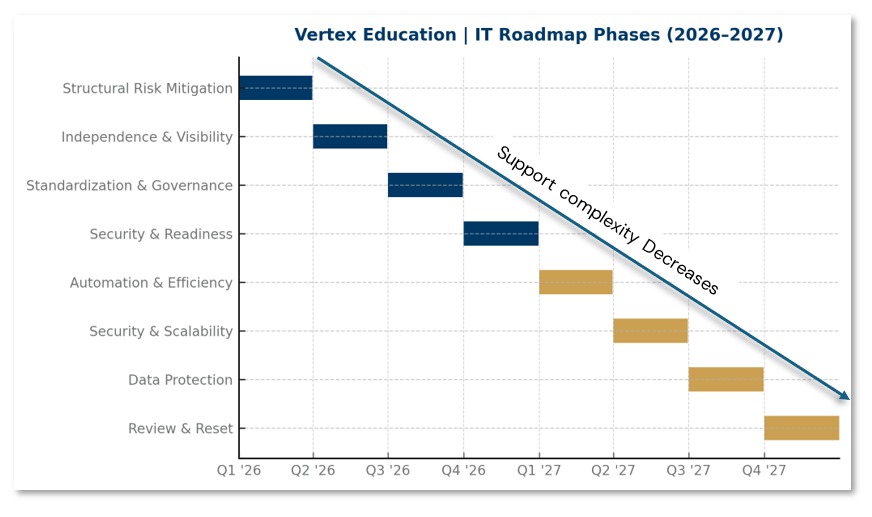
As collaboration and governance improve, the overall complexity of the environment will decrease, resulting in higher efficiency, stronger accountability, and a more proactive helpdesk operation.
Our journey from reactive support to strategic partnership
The journey from IT as a reactive service provider to a strategic business partner follows a predictable value curve. Through continuous improvement and strategic initiatives, IT Central Services will evolve through three distinct phases, each delivering increasing business value to Vertex Education. It is normal when a team goes through the organizational change ITCS has expirenced to see a brief dip in service reliability and support, and I believe we are at the tail end of that dip. Now that we are on / or in the final stages of migrating to one Microsoft 365 tenant our support complexity has gone down dramatically. As we continue to stabilize and optimize our current environment, we will be able to focus more on strategic initiatives that drive business value.
This roadmap is designed to guide us through this transformation, with each initiative strategically sequenced to build the foundation necessary for the next phase of growth and maturity. Put simply the faster we get these items completed, the faster ITCS can stop being an expense and start providing measurable value to the company.
Core values that guide our approach to technology and service delivery
The IT Central Services team operates with a focused, disciplined philosophy that values results, ownership, and adaptability. These principles define how we approach our work, how we scale, and how we continue delivering value across Vertex Education as our systems grow in scope and complexity. These items do not change our focus from the core values or strategic anchors of Vertex but rather are specific principals that make us better IT people in general.
Critical issues influencing roadmap priorities and sequencing
The following challenges reflect architectural, operational, and organizational realities that must be addressed to ensure Vertex IT can continue to scale securely and independently.
Programs that support and enable the roadmap
The K12 division currently operates on non-standard Windows 11 Home devices, which cannot join the Vertex Active Directory domain or comply with security baselines. The hardware refresh initiative will replace these devices with enterprise-grade hardware running Windows 11 Pro or Enterprise editions. Once deployed, all devices will be joined to Active Directory and managed through Intune for patching, encryption, and DLP enforcement. Completion of this initiative will unify security and management across all Vertex entities.
For detailed cost analysis, security justification, and implementation timeline for the K12 laptop refresh program, download the complete business case.
K12 Business Case for Laptop Refresh →The cross-team Tour of Duty program between CSIT and VMSIT establishes a recurring two- to three-week rotation that allows staff from each division to embed temporarily in the other. This initiative fosters knowledge sharing, broadens technical familiarity, and ensures coverage in the event of major incidents. The rotations strengthen interdepartmental relationships and provide career development opportunities while improving operational resilience.
Vertex IT Central Services will continue to grow its network of Subject Matter Experts (SMEs) through Upwork and on-site field contractors through Field Nation. A dedicated budget line needs approval for SME consulting hours. This strategy supports scalability during peak demand periods or specialized projects, without the long-term cost of full-time staffing.
IT Central Services is building a comprehensive executive dashboard that consolidates key performance metrics, operational data, and strategic insights into a single, accessible platform. This dashboard will provide leadership with real-time visibility into IT operations, enabling data-driven decision-making and proactive management.
The dashboard will integrate data from multiple sources including the ticketing system (SLA compliance, ticket volume, breach analytics), infrastructure monitoring (PRTG performance metrics, uptime statistics), asset management (lifecycle tracking, refresh cycles), and security posture (vulnerability assessments, compliance status). By centralizing this information, executives can quickly assess operational health, identify emerging trends, and make informed strategic decisions.
Key features will include customizable views for different stakeholder groups, automated reporting capabilities, trend analysis with historical comparisons, and drill-down functionality to investigate specific metrics or incidents. The goal is to transform raw operational data into actionable insights that support continuous improvement and demonstrate IT's strategic value to the organization.
This is our opporunity to move from reactive suppor, to proactive support, and a plaform for departments to leverage IT as a strategic partner. At a glance it is IT meeting with department leaders to discuss how we are doing, what their goals are, and how we can help them meet those goals with technology.
Our current ticketing process lacks full integration between service requests, incident tracking, and asset management, resulting in data silos and inefficient workflows. Implementing a new ITIL-aligned ticketing system will provide a unified platform to manage incidents, changes, and assets within a single system of record.
By linking assets directly to tickets, IT can gain visibility into device history, user impact, and lifecycle status—enabling faster resolution times, improved SLA compliance, and more accurate reporting. Additionally, this integration supports proactive maintenance, better forecasting for hardware refresh cycles, and stronger accountability across the IT lifecycle.
To meet increasing demand without unnecessary headcount expansion, Vertex IT Central Services will continue developing a hybrid staffing model that combines core full-time staff with a network of on-demand specialists. This approach allows the organization to maintain consistent service standards across all locations without overextending internal resources.
Real-time SLA performance and breach accountability dashboard
The Isha Report is a real-time SLA performance dashboard designed specifically for IT Central Services. Built on the same calculation methodology as the enterprise SLA report in Tableau, the Isha Report provides a narrowed, team-focused view that includes CSAT metrics, breach analytics, and trend data tailored to CSIT operations.
This reporting framework requires team members to document breach justifications on a daily or weekly basis directly within the ticketing system. By shifting accountability from reactive management follow-up to proactive self-documentation, the Isha Report creates a more efficient workflow and establishes a culture of ownership around SLA performance.
The Isha Report transforms SLA management from a reactive compliance exercise into a strategic performance tool. By systematically capturing breach reasons, IT Central Services gains visibility into:
The Isha Report will be built as a custom web application integrated with the ITSM ticketing system. Agents will be prompted to categorize and document breach reasons as part of their daily workflow. The dashboard will provide filtered views for individual agents, team leads, and executives, ensuring each stakeholder sees relevant, actionable data.
Over time, accumulated breach data will feed into predictive analytics and trend forecasting, helping IT Central Services proactively address emerging issues before they impact service delivery. This positions the department to move from firefighting breaches to preventing them entirely.
Experience the Isha Report interface in action. The demo showcases the real-time dashboard, breach analytics, CSAT metrics, and Pareto chart visualizations that will drive accountability and performance improvement.
View Isha Report Demo →Organization, capacity planning, and strategic expansion
IT Central Services operates with intentional discipline around team structure, capacity measurement, and strategic hiring. This section outlines our current organization, how we leverage external talent, the metrics we use to determine when to scale, and the next strategic position we plan to add.
IT Central Services is a 4-person team responsible for covering all enterprise IT service areas. Rather than attempting to be experts in every domain, the team focuses on core competencies while strategically leveraging specialized contractors for advanced technical areas. This approach ensures comprehensive coverage without the overhead of a large full-time staff.
A critical constraint facing IT Central Services is that the 4-person team is based in Arizona while supporting offices coast to coast across multiple time zones. To address after-hours support needs—particularly for East Coast offices where critical issues shouldn't have to wait until Arizona business hours—the team has implemented an on-call rotation leveraging PagerDuty.
This on-call system ensures that urgent IT problems can be escalated and addressed outside of standard Arizona working hours, but it is not a long-term sustainable solution for comprehensive coast-to-coast coverage. As the organization continues to grow and service expectations increase, IT Central Services may need to explore one or more of the following strategies:
Without intervention, the geographic mismatch between the support team's location and the supported user base will become an increasingly significant service delivery challenge, particularly as Vertex continues to expand through M&A activity.
Independent contractors are engaged for projects requiring specialized technical depth beyond the core team's expertise. This includes advanced infrastructure work (server clustering, SAN configuration), specialized platforms (SharePoint architecture, VoIP engineering), security initiatives (penetration testing, compliance audits), and custom development (automation scripts, API integrations). This model ensures IT Central Services can deliver enterprise-grade solutions across all technical domains without permanently expanding headcount.
As the IT Central Services team continues to expand its operational footprint and security responsibilities, a clear model for capacity management is required. The IT / MSP industry adopts a 100:1 user-to-FTE ratio as a benchmark for sustainable workload distribution.
Capacity planning will leverage metrics from the ITSM system including ticket volumes, SLA compliance rates, and infrastructure utilization. As leading indicators trend beyond 90% utilization for more than two consecutive quarters, new roles or external SME capacity will be engaged.
The current ratio doesn't suggest immediate headcount needs but underscores the importance of achieving near-peak efficiency through strategic technology investments and process automation. With the right systems and automation in place, the IT organization's optimal efficiency potential is estimated at 175:1. Using this calculation the CSIT team should be able to support 525 Vertex employees if running at peak performance.
As the environment scales through M&A activity and organic growth, the capacity model will guide staffing decisions—ensuring that IT Central Services can maintain high service levels without overextending resources.
But these are just a few data points. To really calculate team member capacity we will use this template to perform a capacity study.
Download Capacity Analysis Excel Template →As IT Central Services continues to mature, one potential solution to capacity and specialization challenges could be the addition of an Application Portfolio Manager (APM). This role would be a hybrid between helpdesk operations (like Seth), project management, and continuous improvement—essentially a utility player for the CSIT team. The APM's primary responsibility would be staying ahead of application changes: monitoring vendor roadmaps, knowing when applications are rolling out new updates or features, understanding how Windows updates will impact the business before they're released, and ensuring the CSIT team is aware and prepared before changes hit production.
This person would serve as the organization's early warning system for application changes—translating vendor release notes into business impact assessments, coordinating testing windows, communicating proactively with affected departments, and ensuring the team isn't caught off-guard by updates that could disrupt operations. Beyond change management, they would also serve as an organizational connector—conducting Quarterly Business Reviews, coordinating scheduling between departments and M&A entities, running mini-projects with their PM skillset, managing vendor relationships, and acting as a liaison between IT operations and business units. The role requires someone who can shift between strategic planning, tactical execution, and hands-on problem-solving depending on what the team needs most at any given time.
If and when this role becomes necessary, key responsibilities would include maintaining visibility into all major application ecosystems (Microsoft 365, Workday, VOIP, security platforms), managing dependencies, evaluating new technology requests, ensuring post-project documentation is captured, and filling capacity gaps across the team as priorities shift.
Data-driven metrics will guide this decision. After implementing the IT Executive Dashboard and the process for keeping the team accountable for breach reasons, we will know it's time to consider this hire when the largest contributing reasons are "waiting on vendor" or "escalated for complexity." This would indicate that Level 1 & 2 helpdesk agents are spending time researching and communicating with vendors rather than providing rapid high-touch support—signaling a need for specialized capacity in vendor and application management.
For a detailed overview of the Application Portfolio Manager role, responsibilities, and qualifications, download the complete job description.
Download APM Job Description →Listening, measuring, and responding to user needs
IT Central Services is committed to understanding and responding to the needs of the organization through three complementary feedback mechanisms: continuous pulse surveys, ticket-level satisfaction tracking, and structured quarterly reviews. Together, these initiatives create a comprehensive voice of the customer program that ensures IT remains aligned with business priorities and user expectations.
The Quantum Pulse Survey provides lightweight, continuous feedback from users across the organization. These brief, targeted surveys are deployed periodically to gauge sentiment on specific topics—such as recent technology rollouts, service desk responsiveness, or infrastructure performance. Unlike annual satisfaction surveys that provide a snapshot in time, pulse surveys create an ongoing feedback loop that allows IT to detect trends, identify issues early, and measure the impact of improvements in near real-time.
Pulse surveys are designed to be low-friction: typically 3-5 questions, mobile-friendly, and taking less than two minutes to complete. Results are aggregated and reviewed monthly, with action items tracked and communicated back to stakeholders. This demonstrates IT's commitment to listening and responding, not just collecting data.
Customer Satisfaction (CSAT) scores at the ticket level provide granular insight into individual service interactions. By integrating CSAT surveys directly into the ticketing workflow, IT Central Services captures immediate feedback on resolution quality, communication effectiveness, and overall user experience. This data is critical for identifying patterns—such as specific technicians who consistently deliver exceptional service, categories of issues that frustrate users, or processes that introduce unnecessary friction.
Enhanced CSAT reporting will include dashboards showing satisfaction trends by category, technician, department, and time period. Low-scoring tickets will trigger follow-up reviews to understand root causes and implement corrective actions. High-performing interactions will be analyzed to identify best practices that can be scaled across the team. This closed-loop approach ensures that customer feedback drives continuous improvement rather than sitting unused in a database.
Quarterly Business Reviews are a cornerstone of IT Central Services' continuous improvement and governance strategy. They serve as structured, data-driven checkpoints that align technology operations with business priorities, ensuring transparency, accountability, and measurable value delivery across all departments.
Each QBR brings together IT leadership and department heads to review key metrics including ticket volume trends, SLA compliance, asset lifecycle performance, cybersecurity posture, and major project outcomes. These sessions provide a platform to evaluate what is working, what needs adjustment, and where technology can better support organizational goals.
This is our chance to meet proactively and regularly with departments to ask questions like:
"If you could wave a magic wand and solve 1 problem or challenge completely that you have in your business, what would it be?"
"What part about your Technology drives either you or your team crazy?"
"Tell me about your department Goals & Objectives for the next XX months / years?"
QBRs create improved visibility into decentralized software acquisitions. By establishing a regular forum for departments to surface new applications, integrations, and vendor relationships, IT Central Services can proactively address:
Beginning in 2026, QBRs will be scheduled for the last month of each quarter. Reports will draw directly from the ITSM system, ticket analytics, PRTG performance dashboards, and asset management tools. A standardized presentation format will ensure consistency across reviews, enabling year-over-year performance comparison and trend analysis.
Over time, QBRs will serve as the operational heartbeat of IT Central Services — ensuring that as the environment scales and complexity reduces, performance and stakeholder satisfaction remain consistently high.
To ensure consistency and comprehensive coverage across all quarterly reviews, we've developed a standardized QBR agenda template. This template includes all key discussion points, metrics dashboards, and stakeholder engagement sections.
Download QBR Master Agenda Template →Initiative distribution across eight quarters
As time progresses, this roadmap becomes intentionally less rigid and more flexible. Near-term initiatives (Q1-Q2 2026) have defined timelines and deliverables. Mid-term and long-term initiatives are subject to adjustment based on feedback from Quarterly Business Reviews, emerging business needs, resource availability, and changing organizational priorities. This adaptive approach ensures IT Central Services remains responsive to stakeholder requirements rather than rigidly adhering to a predetermined plan that may no longer align with business value.
Complete roadmap with descriptions, value, and timeline
As time progresses, this roadmap becomes intentionally less rigid and more flexible. Near-term initiatives (Q1-Q2 2026) have defined timelines and deliverables. Mid-term and long-term initiatives are subject to adjustment based on feedback from Quarterly Business Reviews, emerging business needs, resource availability, and changing organizational priorities. This adaptive approach ensures IT Central Services remains responsive to stakeholder requirements rather than rigidly adhering to a predetermined plan that may no longer align with business value.
| Tier | Category | Initiative Name | Description | Value | Timeline |
|---|---|---|---|---|---|
| Tier 1 | Infrastructure | Relocate LTS servers to PHX NAP | Move master servers from Chandler HQ to PHX NAP data center | Eliminates single point of failure for all LTS systems | Q1 2026 |
| Tier 1 | Compliance | Microsoft licensing assessment | Replace trial instances with compliant licensing | Ensures legal compliance and predictable costs | Q1 2026 |
| Tier 1 | Physical Security | Vertex-only badge access system | Design and procurement phase for independent access control | Removes security dependency on LTS infrastructure | Q1 2026 |
| Tier 1 | M&A Integration | K12/EdTec Rebranding | Rebrand K12 and EdTec entities to Vertex branding standards | Unifies company identity and strengthens brand consistency across all divisions | Q1 2026 |
| Tier 2 | Budget | SME & contractor budget | Establish dedicated budget line for specialized support | Enables scalable capacity without full-time hires | Q1 2026 |
| Tier 2 | Knowledge Transfer | Tour of Duty program | Initiate cross-team rotations between CSIT and VMSIT | Improves coverage and cross-training | Q1 2026 |
| Tier 2 | Monitoring | PRTG enterprise monitoring | Deploy real-time infrastructure visibility platform | Proactive incident detection and response | Q1 2026 |
| Tier 2 | Data Migration | EdTec Box to SharePoint Migration | Migrate EdTec data from Box to Microsoft SharePoint (ongoing through Q3 2026) | Consolidates collaboration platforms, reduces licensing costs, improves integration | Q1 2026 |
| Tier 2 | Data Management | Data Cleanup - Digital 5S | Implement systematic data organization and cleanup across file shares, SharePoint, and storage systems | Reduces storage costs, improves data findability, and establishes ongoing data hygiene practices | Q1 2026 |
| Tier 2 | Service Delivery | CSAT Ticketing Integration | Integrate customer satisfaction surveys directly into ticketing system workflows | Captures real-time feedback, enables performance tracking, and identifies service improvement opportunities | Q1 2026 |
| Tier 3 | Service Delivery | IT Experience Index | Launch user satisfaction survey program | Measures service quality and identifies improvements | Q1 2026 |
| Tier 1 | Asset Management | Vertex asset management | Implement independent asset tracking integrated with ticketing | Enables lifecycle planning and warranty tracking | Q2 2026 |
| Tier 2 | Network | Meraki standardization begins | Rollout unified network platform at non-Chandler sites | Simplifies remote management and troubleshooting | Q2 2026 |
| Tier 2 | Service Delivery | ITIL-compliant SLA framework | Implement automated escalation workflows | Improves accountability and response times | Q2 2026 |
| Tier 1 | Security | CIS security baseline audit | Assess compliance and develop remediation plan | Establishes minimum security standards | Q2 2026 |
| Tier 2 | Network Security | Replace Palo Alto firewall | Deploy Meraki MX at Chandler headquarters | Reduces costs and simplifies management | Q3 2026 |
| Tier 2 | Automation | Automated provisioning | Integrate user provisioning with HR workflows | Reduces onboarding time and manual errors | Q3 2026 |
| Tier 2 | Governance | Launch QBR cadence | Begin structured quarterly business reviews | Improves alignment and stakeholder trust | Q3 2026 |
| Tier 2 | Collaboration | Teams Rooms modernization | Deploy certified Microsoft Teams Rooms hardware | Reduces support overhead and improves UX | Q3 2026 |
| Tier 2 | Voice Services | Teams Phone System Migration | Migrate Vertex to Microsoft Teams Phone System | Consolidates voice and collaboration platforms, reduces telecom costs | Q3 2026 |
| Tier 2 | Network | Meraki network unification | Complete remote campus rollout | Full network standardization achieved | Q4 2026 |
| Tier 1 | Security | IR exercise & CIS re-audit | Test incident response capabilities and measure progress | Validates security posture improvements | Q4 2026 |
| Tier 2 | Asset Lifecycle | Hardware refresh plan | Develop replacement schedule based on asset data | Proactive hardware management and budgeting | Q4 2026 |
| Tier 2 | Documentation | Consolidate documentation | Centralize standards, SOPs, and onboarding materials | Improves consistency and knowledge retention | Q4 2026 |
| Tier 3 | Automation | 90% provisioning automation | Reach target automation rate for user onboarding | Minimizes manual intervention and errors | Q1 2027 |
| Tier 3 | Collaboration | SharePoint restructuring | Align sites with departmental ownership model | Improves content organization and access control | Q1 2027 |
| Tier 3 | Monitoring | PRTG automated remediation | Enable first-line automated incident resolution | Reduces manual intervention for common issues | Q1 2027 |
| Tier 2 | Governance | QBR review cycle | Focus quarterly reviews on SLA and user experience | Continuous improvement and accountability | Q1 2027 |
| Tier 2 | Network | Finalize Meraki at HQ | Complete network segmentation model at headquarters | Full Meraki standardization complete | Q2 2027 |
| Tier 3 | Security | Advanced identity protection | Deploy Conditional Access, Defender for Identity, advanced MFA | Enhanced identity security and zero-trust posture | Q2 2027 |
| Tier 3 | Security | Penetration testing | Third-party security assessment and M&A playbook development | Validates security controls and prepares for growth | Q2 2027 |
| Tier 3 | Data Protection | Microsoft Purview DLP | Implement data loss prevention policies | Protects sensitive data from unauthorized disclosure | Q3 2027 |
| Tier 3 | Asset Lifecycle | Automated refresh cycles | Enable lifecycle-triggered hardware replacements | Proactive asset management at scale | Q3 2027 |
| Tier 3 | Infrastructure | Azure migration pilot | Test cloud migration approach for on-prem workloads | Prepares for cloud-first strategy | Q3 2027 |
| Tier 3 | Reporting | Annual IT performance report | Comprehensive uptime, SLA, and ROI metrics report | Demonstrates value and informs strategic planning | Q4 2027 |
| Tier 1 | Security | Second security audit | Enterprise-wide policy refresh and compliance validation | Ensures continued security maturity | Q4 2027 |
| Tier 2 | Budget | Contractor utilization review | Evaluate SME/contractor performance and adjust budgets | Optimizes external resource allocation | Q4 2027 |
| Tier 3 | Planning | 2028-2030 roadmap planning | Develop next three-year strategic cycle | Ensures continuous strategic alignment | Q4 2027 |